
Sources for Washington County Previous Residents
Which source helps first depends on the era. Washington County's current parcel tools serve as a bridge. They lead to title records, not to a full history of who lived at an address. Deed records track transfers and legal descriptions. Historical household sources add the people layer. Run the columns as parallel evidence routes, and for each item keep the source date, the address as printed, the person's role, the legal description, the record reference, and what the item actually proves.
| Source | Years It Covers | Where Held | What It Shows |
|---|---|---|---|
| Deed and index series | 1847-1977; county microfilm/index route 1850-1977; deed books 1850-ca. 1964 | Recording Office, State Archives, and historical-vault routes | Title parties, legal descriptions, and transfer chronology, not residency. |
| OHRI estates and naturalizations | Estates 1842-1921; naturalizations 1844-1956 | Oregon Historical Records Index and State Archives | Estate, probate, family, residence, and immigration research leads. |
| Hillsboro Sanborn maps | 1884-1921 | Hillsboro Public Library and map collections | Structure, street, and building context, not a personal name list. |
| Argus and obituary route | Argus 1894-March 2012; obituary index early 1890s-2018, incomplete | Hillsboro Public Library | News and obituary-source leads tied to a date or place. |
| Federal census | Released through 1950 as of 2026 | NARA, Census, and genealogy access points | A household at one census date after confirming locality and district. |
A fresh address question begins with the parcel. An older Hillsboro question may call for a Sanborn map or a newspaper first. Rural land often keeps a legal description even where the modern street form is weak. Keep each source inside its own role. Stretch none of them further.
Washington County Past Residents, Two Trails
Ownership and occupancy run on parallel tracks. A deed chain names a grantor and a grantee. That proves a recorded transfer of title. A directory, newspaper, census, obituary, or probate record instead ties a person to a household or to a moment in local history. The same name sometimes appears on both trails. Often it does not. A tax mailing contact can even differ from the property situs, so treat it as a locate clue rather than proof of physical presence.
For an address history, record the current situs address, tax lot or R number, legal description, and any historic spelling as separate fields. Lots get split. They also get replatted, or restated in township, range, section, or Donation Land Claim language. When street wording changes, the legal description is often the stable bridge.
Note: A gap between title and household evidence should stay a gap until a dated, independent source supports the connection.
Washington County Parcel First
Begin a previous-residents search with Washington County's InterMap instructions. The documented lookup keys are Situs Address, Tax Lot ID, and R number. Select the location first. The Additional Information panel then leads to Assessment & Taxation Information and its general property, sales/deed, assessed-value, improvement, and improvement-detail reports. County instructions offer no public name-search form. No ZIP filter or grantor-grantee web index appears either.
The route is address, then parcel or tax lot, then legal description, then recorded instrument. Take the legal description and a document reference to the Recording Office. Staff cannot work from a street alone. Survey Explorer can help. It bridges a subdivision, plat, road dedication, or former legal description, though its historic section maps are not a current-boundary source after April 25, 2012.
Washington County Previous Residents and Deeds
The deed chain starts at the current parcel record. From there, work backward through recorded instruments. Washington County's Recording Office anchors the verified channels, alongside lobby viewing, phone or email ordering, historic index and deed-book microfilm, and State Archives coverage guidance. The historical series spans 1847 to 1977. Direct and indirect indexes run 1850 to 1977 through the county microfilm route. Deed books A-I span 1850 to about 1883; K-Z and 26-520 run from about 1883 to 1964, and the Book of Records begins in 1964.
- Record the parcel's tax lot or R number, legal description, current recorded party, and any visible document reference.
- Request or inspect the current transfer instrument using its reference, party names, or legal description.
- Identify the grantor, the party transferring title, and the grantee, the party receiving it, with the recording date and book/page or recording number.
- Search the seller as a grantee in the earlier acquisition, then repeat while matching the legal description and noting corrections, easements, or quitclaims.
- When the current material ends, move to the direct/indirect indexes, microfilm, and deed books rather than inventing an online cutoff.
- Grantor / grantee
- The grantor transfers property; the grantee receives it in the recorded instrument.
- Chain of title
- A dated sequence of recorded transfers for one legal parcel, not a list of everyone who stayed there.
- Legal description
- A lot, block, subdivision, township-range-section, or Donation Land Claim identifier used to connect changing address forms.
The Oregon State Archives Washington County inventory records the county's historical deed and index coverage.
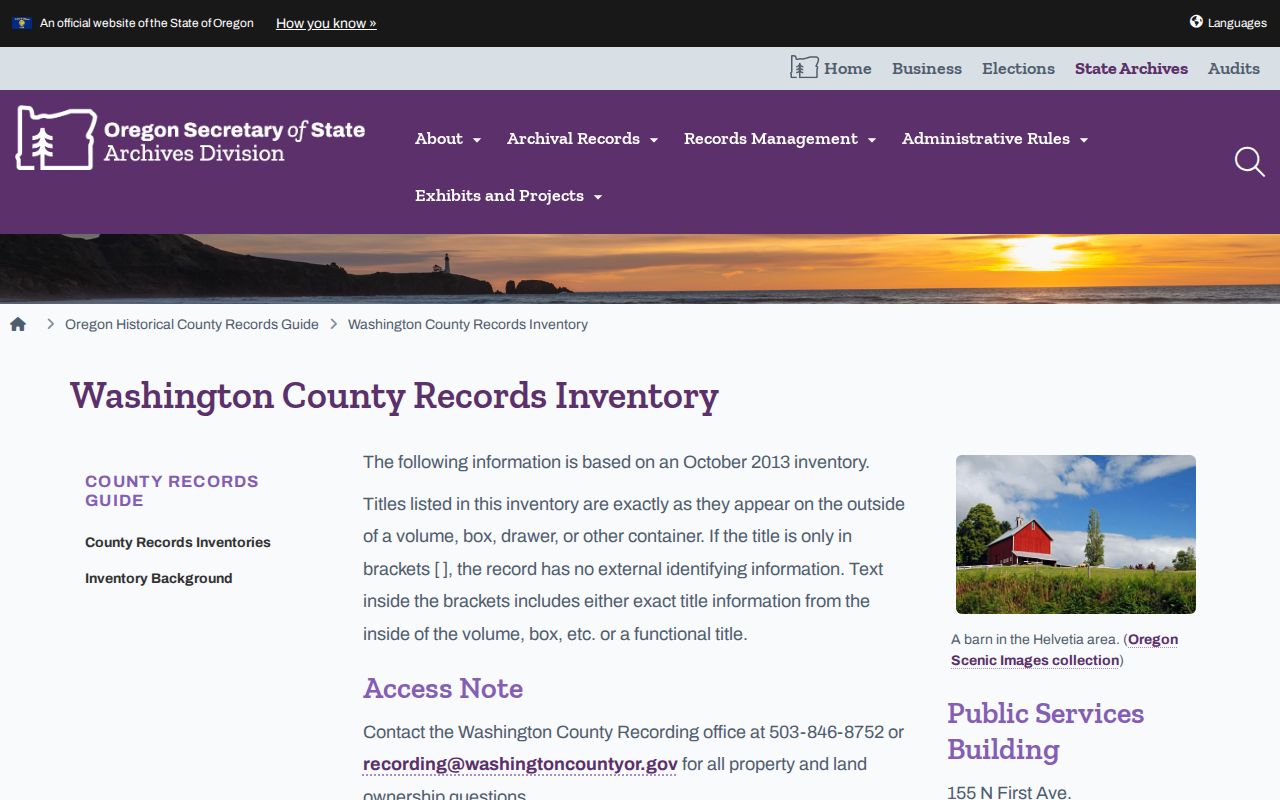
Documents from 1979 forward are searchable at the Suite 130 Public Research Area computers. Both images and indexing live there. Earlier work belongs in the historical indexes and microfilm. The county publishes no current public grantor-grantee web index. So the terminal and the counter remain the accurate next steps for deed-chain work.
The Recording Office separates viewing from copying. Lobby document viewing is free once the reference is known; copies are ordered by phone or email after prepayment, and staff-made or certified copies carry their own charges. Keep a small evidence log for each instrument. Record the recording date, the parties and their roles, the legal description, the recording number or volume and page, and a short note on the document type. That habit protects the chain from a same-name error or a correction instrument mistaken for an ordinary transfer.
Washington County Past Residents and Address Changes
Hillsboro's Connecting Hillsboro project is a practical warning for past-residents research. Its major phases from 2015 to 2020 merged the former City and County addressing systems. The City grid held about 44,000 addresses at the start. The County grid held about 11,000. Keep both forms with the phase and date. A mismatch may appear in a directory, newspaper, census, or deed-related note. That mismatch may reflect readdressing rather than a move.
For Hillsboro context, City addressing information sets the grid origin. It stands at First Avenue and Main Street. Elsewhere in the county, start with the tax lot and the legal description. Do this before assuming a postal city label matches the right historic geography.
Past Households in Washington County Records
A title chain needs a household layer. The Brookwood library's Hillsboro directory route begins with a 1959 volume. A 1975 reference volume also exists. Coverage of complete directory sets and reverse volumes varies. So ask at the reference desk before counting on a run of editions. With an actual volume in hand, start from the title page and edition year. Then compare the name or address listing against the nearest released census. Federal census schedules follow a 72-year release rule. The 1950 count is the latest general release.
The practical chronology runs in order: directory or newspaper date, address as printed, nearest census date, deed or probate date, and obituary source. Hillsboro Sanborn maps date from 1884 through 1921. They offer a check on structures and streets, not on household names. The Washington County city directory collections route explains how to inspect a local volume without guessing at gaps. It helps you spot a gap before you trust an edition.
Lawful personal house history. Use Washington County historical records for family history, property history, estate research, and personal curiosity. Do not use a historical trail to stalk, harass, or harm anyone.
Washington County Previous Residents in OHRI
The Oregon Historical Records Index extends an address trail where the directory shelf stops. For Washington County, its estates span 1842 through 1921. Its naturalizations span 1844 through 1956. Estate files can open into probate material, heirs, a representative, and court references. Naturalization papers may carry residence, family, immigration, and witness details. All are subject to the archive's record and access rules.
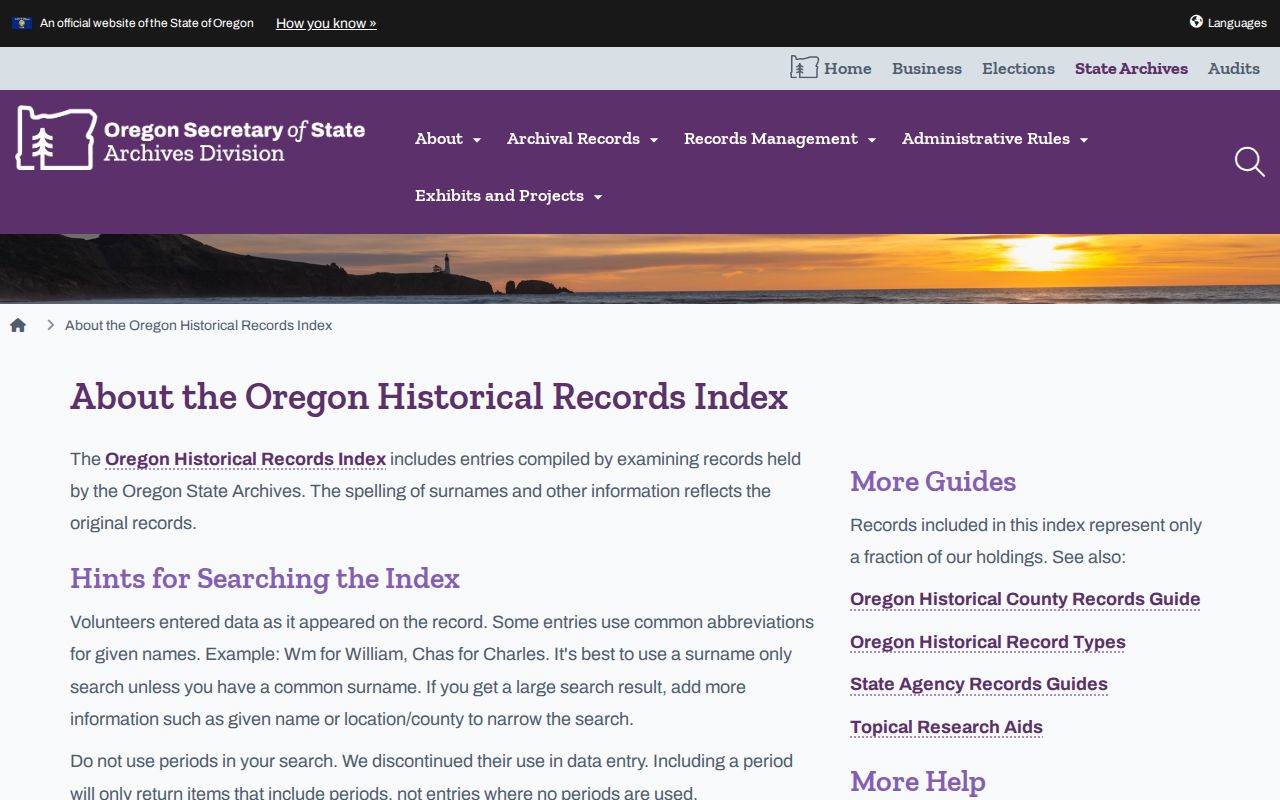
Let the index point you to one record and its repository. Then request that item alone. An index entry is a lead. It is not proof that a similar name belongs in your parcel history. Rural areas make this especially important, because the legal description outlives any familiar address.
Washington County Past Residents and Obituaries
The Hillsboro Obituary Index earns its place at the end of a past-residents trail. Coverage runs from the early 1890s through 2018, though it stays incomplete. Searchable fields include last name, first name, middle name or initial, and maiden name. You can also search by date of death, birth date, spouse, survived by, and obituary source. Result headings give last name, first name, date of death, and date of birth.
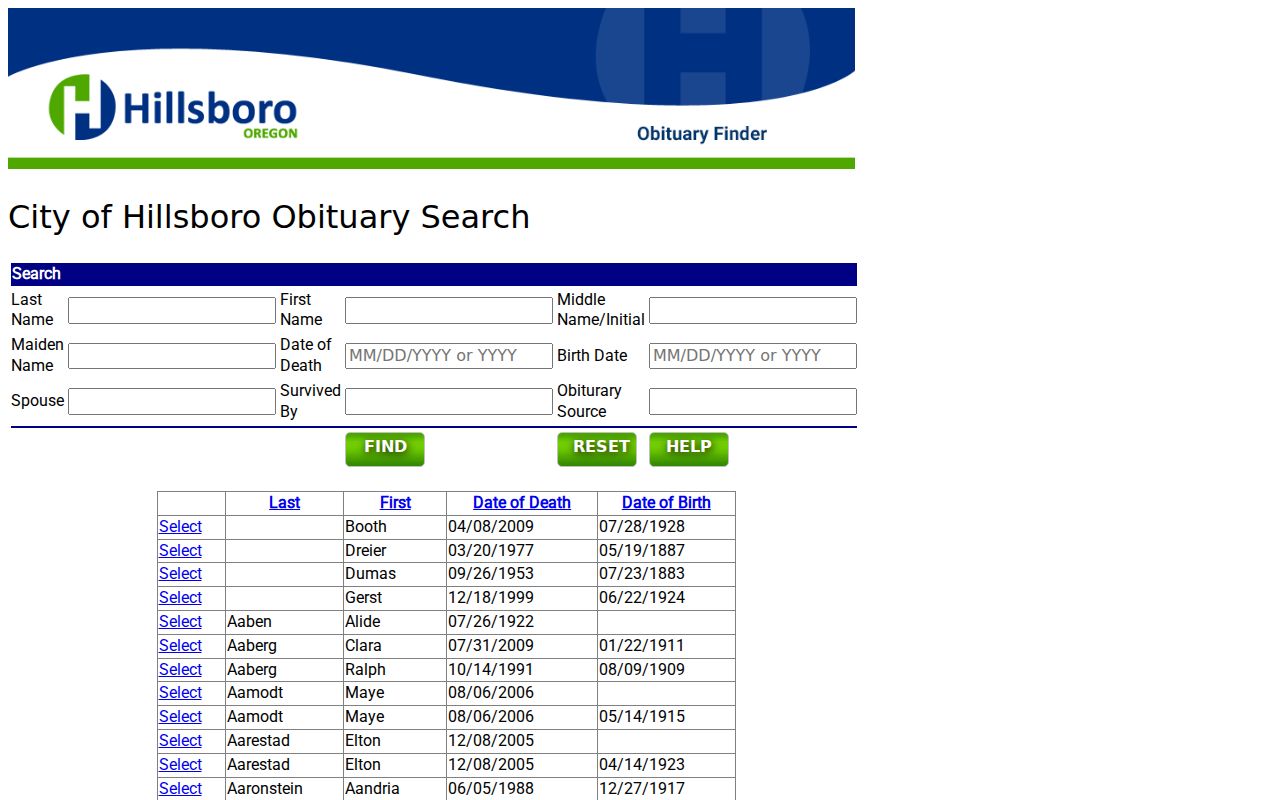
A match is only a pointer. Retrieve the source obituary for its actual date, relationships, and newspaper context. A nonmatch proves nothing, since the index is not exhaustive. Pair the source obituary with Argus microfilm, probate, a cemetery record, or census evidence as the dates demand.
Washington County Past Residents Abstract Requests
One historical extension is the former museum's Five Oaks Abstract Land Deed collection. It refers to deeds from roughly 1850 to 1940. The collection once had an index binder. It is not an open shelf or an online database. During the County Historical Collection cataloging transition, keep any request narrow. Name the address or legal description. Add the time span. Name the Abstract Land Deed collection itself.
This path pays off best after parcel and deed work has isolated a period. It works the same way for a missing transfer. Include the direct or indirect index range. Add a deed book or volume if you know one. Give the current or historical address form too. That approach respects the collection's changing stewardship. It also keeps an unverified title-company abstract from standing in for the recorded deed. A reply saying the series is still being inventoried is a documented endpoint. Treat it as such. It is not grounds for inferring a prior household or a move date.