
Washington County City Directory Collections
Local city directories sit inside a wider historical network. The confirmed shelf route is Hillsboro Public Library's Brookwood genealogy collection, which lists “Directories” among its local-history materials. A WCCLS catalog record also confirms a Hillsboro, Oregon, City Directory: a Classified Business Directory, a Rural Route Directory series from 1959 onward and displays a 1975 reference holding. That is a starting point, not proof of a complete annual sequence or a countywide run.
| Collection | Years | Where Held | Access |
|---|---|---|---|
| Hillsboro catalog-confirmed directory route | 1959 onward; 1975 reference holding displayed | Hillsboro Public Library / WCCLS catalog | Ask Brookwood reference staff for the target volume and use conditions. |
| Brookwood “Directories” collection category | Exact years not published online | Hillsboro Public Library genealogy resources | Local-history enquiry; confirm place, edition, and format. |
| Washington County Heritage Online | Mostly 1850s to present | WCHO | Online discovery of 10,000+ historic items; original materials stay with contributors. |
| Pacific University institutional material | Yearbooks 1894-1996; student directories 1948-1985 | Pacific University Archives, Forest Grove | Arrange an appointment or consultation and follow copying guidance. |
Publisher names, complete year runs, online images, reverse coverage, and entry conventions were not verified in the inspected official sources. Keep those fields blank until the actual volume is in hand. The title page and an answer from the reference desk outrank an inferred date range.
That collection question should be stated with the place name first. A Hillsboro volume may serve a different area from a Beaverton, Forest Grove, Tigard, Sherwood, Cornelius, or rural-route volume. Ask whether the requested edition is a regular name directory, a telephone book, a classified business directory, or a reverse listing, then ask whether its geographic coverage includes the address under study. The library’s catalogue route is useful precisely because it keeps those choices open rather than pretending that a countywide annual directory has been confirmed. For an on-site visit, also ask about microfilm-reader access, copying limits, and whether a reference librarian can retrieve a volume from local-history storage.
Washington County City Directory Inspection Gap
No authoritative digitized Washington County directory entry was found for inspection. That means the local evidence does not confirm a publisher-specific abbreviation key, spouse style, ownership notation, reverse section, or complete calendar of editions. It also does not justify treating a Portland volume as a Washington County source. Ask for a regular directory, telephone book, and any criss-cross or street-number index separately, giving the locality and decade.
At the desk, first check the title page, imprint, year, geographic scope, and any directions page. Then compare the printed locality with Hillsboro, Beaverton, Forest Grove, Tigard, Sherwood, Cornelius, or an unincorporated community. WCCLS member libraries and Pacific University may have different restrictions, so a catalog hit alone is not a promise that the relevant volume can be consulted or copied.
Note: A missing listing can reflect a rural omission, an unlisted address, a new structure, or a changed street number rather than a missing household.
Washington County Records Beside the Directory Shelf
Brookwood supplies useful checks around a printed listing. Its local-history holdings include Hillsboro Argus microfilm from 1894 through March 2012, the Hillsboro Independent from 1891 through 1931, and the Forest Grove Independent for 1873-1874. The same collection has Hillsboro Sanborn maps for 1884-1921, county jail, court, marriage, and estate microfilm, plus an early-1890s-to-2018 obituary index that the library expressly labels incomplete.
A newspaper notice can supply a date or street wording that a listing lacks. A Sanborn sheet can test whether a structure or street arrangement existed in the edition year, but it does not name a household. The obituary index is a pointer to an original source, not a final identity decision. Search its name variants, retrieve the cited obituary, and preserve the original publication details.
Brookwood also identifies FamilySearch Affiliate access as available only on library computers or public Wi-Fi. That on-site limitation matters when a catalog result points beyond the open web. Ask staff which route applies before planning a visit, and note whether the useful item is microfilm, a local volume, a restricted database, or a record held by another repository.
Washington County Directory Heritage Transition
The Washington County Historical Collection is the physical counterpart to online discovery. Five Oaks Museum closed in late 2024, its building and collections returned to county stewardship in April 2025, and the county approved a 3-5-year inventory and cataloging project in 2026. A detailed request can be handled remotely when possible or by appointment when the material requires it. Include a person, place, date span, subject, and desired format.
The County Historical Collection research page explains the evolving archival route during that stewardship change.
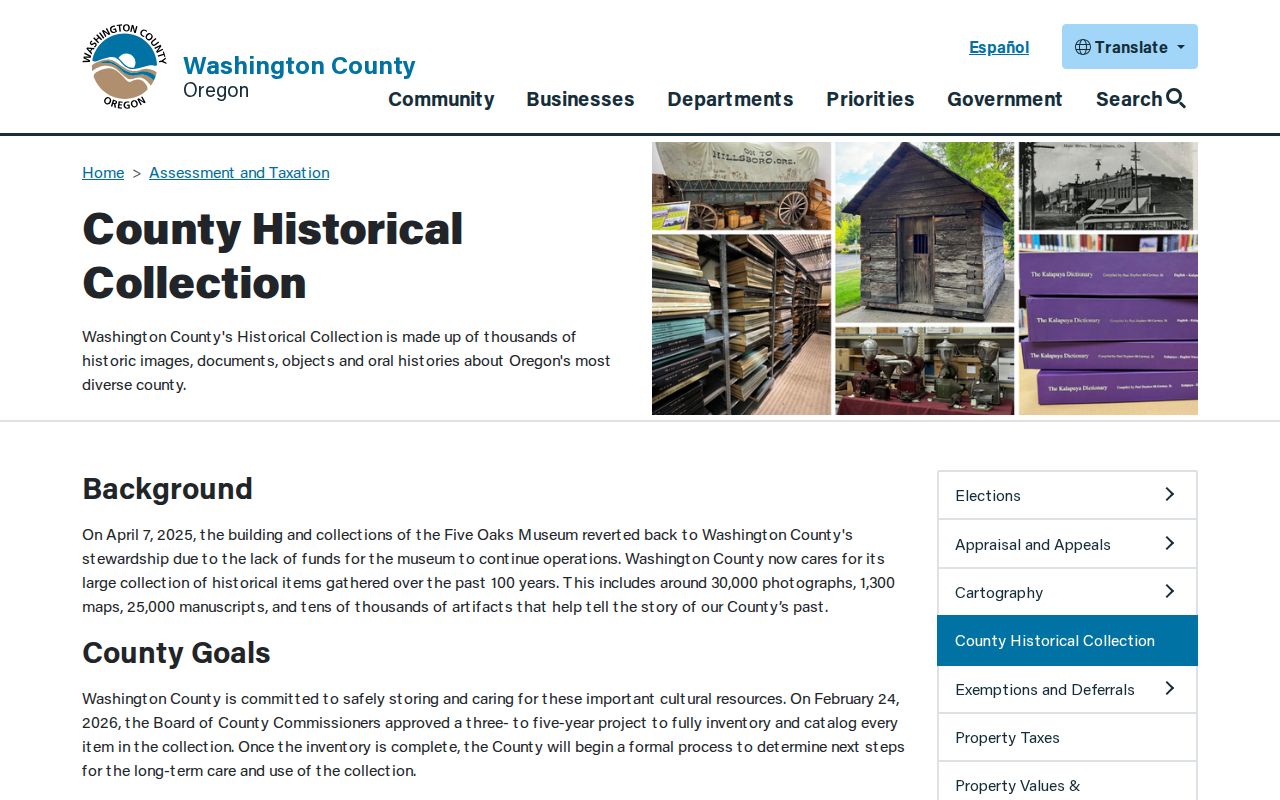
WCHO complements that request channel. Pacific University administers the portal, which upgraded to Omeka S version 4 in 2025 and makes more than 10,000 primarily 1850s-to-present images and documents discoverable through local contributors. Search a street, school, neighborhood, or town alongside a name, then record the caption, date, and collection identifier.
Contributor names are part of the search method. Pacific University Archives, Beaverton, Cornelius Public Library, Forest Grove City Library's Stewart History Room, Banks Historical Society, Tigard Public Library, and community projects retain their original material even when an item is discoverable through WCHO. A caption may connect a photo to a location, but the source repository controls the original object and any deeper research request. That distinction matters while the physical county collection is being inventoried.
Reading a Washington County City Directory
Read a local volume as an artifact of its own edition. City directories commonly organize a person or business under a printed name and may include an address, a spouse or household notation, an occupation, and a business address. Those are general directory conventions, not verified field labels for a Washington County edition. Capture only what the inspected page actually prints, including punctuation and abbreviations.
| Printed name | Record the spelling, initials, suffixes, and page number exactly as shown. |
|---|---|
| Household wording | Capture any spouse or relationship wording only if the edition prints it. |
| Address | Keep the house number, street form, town, and any business address separate. |
| Occupation line | Transcribe the occupation or organization wording, without expanding abbreviations from memory. |
| Edition evidence | Photograph or note the title page, date, publisher, abbreviation key, and page citation under the library's copying policy. |
- Criss-cross directory
- An address-to-listed-name section, if that edition includes one. Confirm it exists before relying on it.
- Householder index
- An index arranged around a household heading or surname. Its rules vary by publisher and edition.
- Abbreviation key
- The volume's own explanation of shorthand. Capture it before interpreting an entry.
Washington County Directory Companions
For a Forest Grove connection, Pacific University Archives adds a distinct institutional route. Its Heart of Oak yearbooks run from 1894 to 1996, and Pacific University People student directories appear in various years from 1948 to 1985. The archives holds Pacific and Tualatin Academy materials, pioneer and Forest Grove documentation, photographs, catalogs, and newspapers. An appointment or consultation is the documented way to use the material.
Those records can place a person in a time, school, or community. They do not prove a residential address. Pair an institutional lead with the relevant directory edition, an address source, newspaper evidence, or a census record before drawing a household conclusion. For older Washington County history, the State Archives inventory also notes early estate, guardianship, naturalization, tax-roll, deed, and court material. The repository and record series determine the next request, especially when a locality changed names or a street address did not yet exist.
Tracing Washington County City Directories
A household trail should keep directory evidence separate from property evidence. Start with a stable clue such as a full name and town, a current situs address and tax lot, or a historic legal description. Then put each edition beside its own date. Federal population schedules are released after 72 years, so 1950 is the latest general census available as of 2026. Census records offer a snapshot for one census date, while a directory can supply an intervening published listing.
- Ask for the nearest confirmed local volume and record its title page, date, publisher, and geographic scope.
- Transcribe the exact spelling and printed address, then check adjacent available editions without assuming every year survives.
- If the library confirms a criss-cross section, compare the address-to-listed-name entry with the name section.
- Pair the result with the nearest released federal census and preserve the census date as a separate point in time.
- Use Argus microfilm, a Sanborn sheet, an obituary source, a deed, or probate material to test the address and transition.
A name disappearing from an edition is not a conclusion. It may indicate a move, a death, a changed spelling, a rural or unlisted address, a changed street number, or a gap in the available run. For a current address-keyed record chain, use the Washington County streets resource rather than asking an old directory to answer a present-day question.
Washington County Directory Timeline
Local record history explains why different shelves answer different dates. Washington County began as Twality County in 1843 and took its present name in 1849. Early land, estate, and court records can use historic place language or a legal description instead of a familiar street address. The timeline below keeps the documented historical layers in order without pretending they are one continuous city-directory run.
- 1873-1874: Forest Grove Independent microfilm begins the verified early newspaper layer.
- 1884-1921: Hillsboro Sanborn maps document structure and street context.
- 1891-1931 and 1894-March 2012: Hillsboro Independent and Argus microfilm provide local notices across long spans.
- 1959 onward: the Hillsboro directory route is catalog-confirmed, with a 1975 reference holding displayed.
- 2025-2026: WCHO's platform update and the county cataloging project expand discovery while physical stewardship remains in transition.